
How many bags of concrete are in a yard of concrete? Generally, it takes about five to six 80-pound bags of concrete mix to make one cubic yard of concrete. The exact number can vary depending on the specific product and its coverage.
When you’re planning a concrete project, whether it’s a small patio, a driveway, or a foundation, knowing how much concrete you need is crucial. Running out of concrete halfway through a pour is a common and frustrating problem. Conversely, ordering too much can lead to wasted material and extra cost. This guide will break down the process of calculating concrete bags and explain the relationship between bags of concrete and a cubic yard. We’ll delve into the details of concrete per cubic yard and help you answer the question: How many bags of concrete in a yard of concrete?
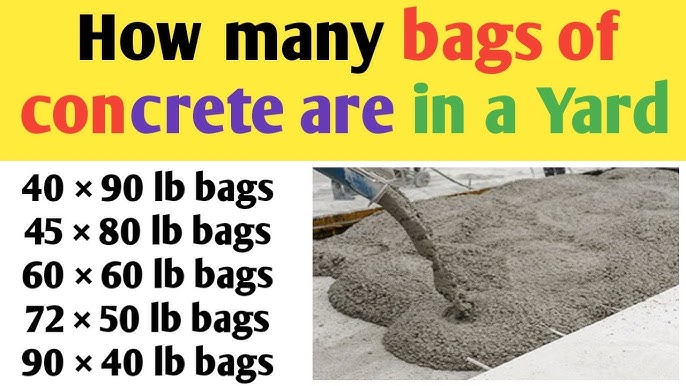
Image Source: i.ytimg.com
Deciphering Concrete Volume: The Cubic Yard
Before we talk about bags, let’s get clear on the unit of measurement: the cubic yard. A cubic yard is a measure of volume. Imagine a cube that is three feet long, three feet wide, and three feet high. That entire cube is one cubic yard.
- 1 cubic yard = 3 feet x 3 feet x 3 feet = 27 cubic feet.
This is the standard way concrete is measured and sold by ready-mix companies. When you order concrete, you’re ordering a volume, typically in cubic yards. But if you’re using bagged concrete, you need to translate that volume into the number of bags required.
Standard Concrete Bag Sizes and Coverage
The most common concrete mixes sold in bags come in two primary weights: 60 pounds and 80 pounds. Smaller bags, like 40 or 50 pounds, are often available for smaller repairs or specialty mixes, but for larger projects, the 60 lb and 80 lb bags are the go-to.
The amount of concrete each bag yields is important for our calculation. This is often stated on the bag itself or can be found in the product’s specifications.
80-Pound Bags
- Yield: An 80-pound bag of concrete mix typically yields about 0.60 cubic feet of concrete.
60-Pound Bags
- Yield: A 60-pound bag of concrete mix typically yields about 0.45 cubic feet of concrete.
These are approximate figures, and it’s always best to check the packaging of the specific concrete mix you plan to use. Sometimes, the coverage is stated in square feet for a specific depth. For instance, a bag might cover 0.5 square feet at a 4-inch depth.
Calculating Bags of Concrete Per Yard
Now we can put it all together to answer the main question. We know that 1 cubic yard equals 27 cubic feet. We also know how much volume each bag yields.
For 80-Pound Bags:
To find out how many 80-pound bags are needed for one cubic yard, we divide the total cubic feet in a yard by the cubic feet yielded by one bag:
- Number of bags = Total cubic feet per yard / Cubic feet per bag
- Number of bags = 27 cubic feet / 0.60 cubic feet/bag
- Number of bags ≈ 45 bags
So, approximately 45 of the 80-pound bags are needed to make one cubic yard of concrete.
For 60-Pound Bags:
Using the same logic for 60-pound bags:
- Number of bags = Total cubic feet per yard / Cubic feet per bag
- Number of bags = 27 cubic feet / 0.45 cubic feet/bag
- Number of bags = 60 bags
Therefore, it takes roughly 60 of the 60-pound bags to create one cubic yard of concrete.
Practical Implications: How Much Concrete Do I Need?
It’s rare for a project to require precisely one cubic yard of concrete. Most projects involve calculating a specific volume based on the dimensions of the area you need to fill. This is where concrete estimating becomes vital.
To calculate the concrete volume for your project, you’ll need to measure the length, width, and depth of the area you want to pour.
Concrete Volume Calculation Steps:
- Measure Length: Measure the longest side of your area in feet.
- Measure Width: Measure the shortest side of your area in feet.
-
Measure Depth: This is the thickness of your concrete pour. It’s often measured in inches. For most common applications like sidewalks, patios, and driveways, a depth of 4 inches is standard. For heavier loads or reinforced structures, 6 inches might be necessary. Crucially, you must convert this depth from inches to feet. To do this, divide the depth in inches by 12 (since there are 12 inches in a foot).
- Example: 4 inches / 12 = 0.333 feet
- Example: 6 inches / 12 = 0.5 feet
-
Calculate Volume in Cubic Feet: Multiply the length, width, and depth (all in feet):
- Volume (cubic feet) = Length (ft) x Width (ft) x Depth (ft)
-
Convert to Cubic Yards: Divide the total volume in cubic feet by 27 (since there are 27 cubic feet in a cubic yard):
- Volume (cubic yards) = Volume (cubic feet) / 27
Example Calculation:
Let’s say you want to pour a small patio that is 10 feet long, 8 feet wide, and 4 inches thick.
- Length = 10 feet
- Width = 8 feet
-
Depth = 4 inches = 4/12 feet = 0.333 feet
-
Volume (cubic feet) = 10 ft x 8 ft x 0.333 ft = 26.64 cubic feet
-
Volume (cubic yards) = 26.64 cubic feet / 27 cubic feet/yard = 0.987 cubic yards
So, you need just under one cubic yard of concrete for this patio.
How Many Bags of Concrete in a Yard of Concrete? (Revisited with Projects)
Once you have your required volume in cubic yards, you can then use the bag yield figures to determine the number of bags needed.
Using the Patio Example (0.987 cubic yards):
-
If using 80-pound bags (0.60 cubic feet/bag):
- Total cubic feet needed = 0.987 cubic yards * 27 cubic feet/yard = 26.64 cubic feet
- Number of 80 lb bags = 26.64 cubic feet / 0.60 cubic feet/bag = 44.4 bags. You’d likely round up to 45 bags.
-
If using 60-pound bags (0.45 cubic feet/bag):
- Total cubic feet needed = 26.64 cubic feet
- Number of 60 lb bags = 26.64 cubic feet / 0.45 cubic feet/bag = 59.2 bags. You’d likely round up to 60 bags.
The Importance of Concrete Mix Ratio
The concrete mix ratio refers to the proportions of cement, aggregates (sand and gravel), and water used to create the concrete. Standard pre-mixed concrete bags contain the correct dry ingredients. All you need to add is water.
The amount of water you add is critical. Too much water weakens the concrete, making it less durable. Too little water makes the mix difficult to work with and can lead to improper hydration of the cement. Follow the manufacturer’s instructions on the bag precisely for the best results.
The standard concrete mix ratio for general-purpose concrete is often around 1:2:3 (cement:sand:gravel) by volume, but this is already pre-mixed in the bags. Your job is to get the water ratio correct.
Using a Concrete Bag Calculator
To simplify the concrete estimating process, many online tools and apps offer a concrete bag calculator or bagged concrete calculator. These are incredibly useful for ensuring accuracy.
Typically, you input:
- The dimensions of your project (length, width, depth).
- The type or weight of the concrete bags you plan to use (e.g., 60 lb or 80 lb).
The calculator will then perform the concrete volume calculation and tell you how many bags you need. Some calculators even allow you to input the specific yield of a particular brand’s bag if you have that information.
Benefits of using a concrete bag calculator:
- Accuracy: Reduces the chance of calculation errors.
- Time-saving: Quickly provides the necessary information.
- Convenience: Accessible on any device.
It’s always recommended to check your calculations against a calculator to double-check your concrete estimating.
Factors Affecting Concrete Yield
While the standard figures for bags of concrete per yard are helpful, several factors can subtly influence the actual yield:
1. Water Content:
As mentioned, the amount of water added is crucial. If you add slightly more water than recommended, you’ll get a bit more volume, but at the cost of strength and durability. Conversely, adding less water will result in a stiffer mix with less overall volume.
2. Compaction:
When concrete is poured, it needs to be vibrated or compacted to remove air pockets. This process reduces the overall volume slightly as the material settles. For most DIY projects, manual rodding or tapping will achieve this.
3. Bag Quality and Brand:
Different manufacturers may have slight variations in their product density or particle size distribution, which can lead to minor differences in yield. Always refer to the specific product’s yield information if available.
4. Site Conditions:
For uneven subgrades, you might end up needing slightly more concrete than your initial calculation if you’re not careful with your depth measurement and leveling.
Tips for Estimating Concrete Needs
- Measure Twice, Order Once: Double-check all your measurements and calculations before purchasing bags.
- Add a Buffer: It’s wise to purchase about 5-10% more bags than your calculation suggests. This accounts for spillage, minor measurement errors, or if you need to patch any low spots. Running out of concrete mid-pour is a much bigger problem than having a couple of extra bags.
- Consider Depth Variations: If your pour depth isn’t uniform, estimate the average depth or calculate the volume for different sections.
- Factor in Reinforcement: If you’re using rebar or mesh, ensure your depth calculation accounts for the space needed for these materials.
- Consult Professionals: For large or complex projects, consider getting a professional estimate.
Why Accurate Concrete Estimating Matters
Cost Savings:
Buying the correct amount of concrete prevents overspending on excess materials. For larger projects, this can be a significant saving.
Project Efficiency:
Having all the necessary materials on hand avoids delays. If you run out, you’ll have to stop, go to the store, and potentially wait for the partially poured concrete to set before you can continue, which can compromise the integrity of the finished product.
Quality of Finish:
Pouring concrete is a time-sensitive process. Running out and having to restart later can lead to cold joints (seams where new concrete meets old, hardened concrete), which are weak points and can be visually unappealing.
Frequently Asked Questions (FAQ)
Q1: What is the difference between 60 lb and 80 lb bags of concrete?
A: The main difference is the amount of concrete mix in each bag, which directly impacts the yield. An 80 lb bag yields more concrete than a 60 lb bag. Generally, an 80 lb bag yields about 0.60 cubic feet, while a 60 lb bag yields about 0.45 cubic feet.
Q2: Can I mix different brands or types of concrete for the same project?
A: It’s generally not recommended. Different mixes have varying cement content, aggregate sizes, and additives, which can affect the final strength, durability, and appearance of the concrete. Stick to one product for consistency.
Q3: How do I calculate the concrete needed for a wall or post?
A: For walls, you’ll calculate the volume as length x width x height. For round posts, the formula for the volume of a cylinder is π * radius² * height. Remember to convert all measurements to feet and then divide by 27 for cubic yards.
Q4: What if my project has irregular shapes?
A: Break down irregular shapes into simpler geometric forms (rectangles, squares, circles). Calculate the volume for each section and then add them together.
Q5: How much extra concrete should I buy?
A: It’s a good practice to buy an extra 5-10% of concrete to account for any unforeseen issues, minor spills, or slight variations in depth.
Q6: Is there a difference between “concrete mix” and “mortar mix”?
A: Yes. Concrete mix is designed for structural applications and contains coarse aggregates (gravel). Mortar mix is used for binding bricks or stones and typically contains only fine aggregates (sand).
Conclusion: Mastering Your Concrete Bag Count
How many bags of concrete in a yard of concrete? As we’ve explored, the answer typically hovers around five to six 80-pound bags, or about sixty 60-pound bags for a full cubic yard. However, the true art lies in accurate concrete volume calculation based on your project’s specific dimensions.
By carefully measuring your project area, converting all measurements to feet, and utilizing the yield information for your chosen standard concrete bag size, you can confidently determine how much concrete do I need. Employing a concrete bag calculator can further enhance accuracy in your concrete estimating. Remember to always factor in a little extra to ensure your project is completed without interruption and with the best possible outcome. With this knowledge, your next concrete project will be well within your grasp.