
So, you want to measure your yard? You’re in the right place! This guide will walk you through exactly how to measure your yard, from the tools you’ll need to the final calculations. We’ll cover everything you need to know about measuring land accurately, understanding property boundaries, and calculating your lot size.
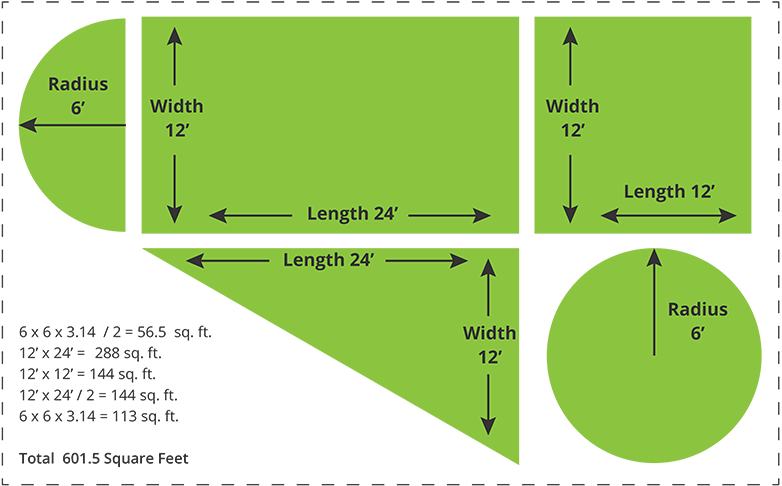
Image Source: gvt.net
Why Measure Your Yard?
Measuring your yard might seem like a simple task, but it’s surprisingly useful for many reasons. Whether you’re planning a landscaping project, installing a fence, putting in a pool, or even just curious about your property’s dimensions, knowing how to measure your yard is essential. It helps you budget for materials, avoid costly mistakes, and ensure your projects fit perfectly. Accurately measuring land can also be crucial if you’re dealing with property disputes or need precise data for official purposes.
Planning Your Garden or Landscape
When you’re dreaming up a new garden bed, a patio, or a playground, having exact measurements is key. You need to know how much space you have for plants, where to place features, and how much material like mulch or soil you’ll need. Measuring your yard gives you the blueprint for your outdoor vision.
Installing Fences or Borders
Putting up a fence or defining property boundaries requires precise measurements. You don’t want to buy too much fencing material, nor do you want to come up short. Accurate land measurement ensures your fence is installed correctly along your property lines.
Home Improvement Projects
Major home improvement projects often extend into the yard. If you’re adding a deck, a swimming pool, or even just a new driveway, knowing your yard’s exact dimensions is the first step. It helps with permits, contractor quotes, and the overall design.
Property Value and Taxes
While not always a DIY task, understanding your lot size is fundamental to property value. Tax assessments are often based on land area, so knowing your measurements can be helpful in reviewing those figures.
Essential Measuring Tools for Land
Before you start, gather the right tools. Having good measuring tools for land will make the job easier and more accurate.
- Measuring Tape for Property: A long, durable measuring tape is your primary tool. Look for one that is at least 100 feet long, preferably with a strong metal tape that won’t easily kink or break. Fiberglass tapes are also good as they don’t stretch as much as some metal tapes.
- Measuring Wheel (or Rolling Measuring Device): For very large yards or long, straight lines, a measuring wheel can save time and effort. You simply walk the perimeter, and the wheel measures the distance as it rolls.
- Stakes or Markers: You’ll need stakes or flags to mark corners or points along your property boundaries. Wooden stakes, metal rebar, or even brightly colored flags work well.
- Hammer or Mallet: To drive stakes into the ground.
- Pen and Paper or Digital Device: To record your measurements.
- Calculator: For calculating area and acreage.
- Optional: GPS Device or App: For more advanced measurements, especially for irregularly shaped properties or larger tracts of land.
How to Measure Property: The Basic Steps
Measuring your yard might seem straightforward, but accuracy is important. Let’s break down how to measure property step-by-step.
Step 1: Obtain Your Property Survey or Deed
The most accurate way to start measuring land is to refer to your official property survey or deed. This document will usually provide the exact dimensions of your property lines and may even have a diagram. If you don’t have these documents, you can usually obtain them from your local county recorder’s office. This is especially helpful for defining your property boundaries.
Step 2: Identify Your Property Boundaries
Your property boundaries are the legal lines that separate your land from your neighbors’ or public property. These are often marked by:
- Fences: While fences can indicate boundaries, they might not always be perfectly placed on the exact property line.
- Survey Markers: Metal rods or stakes, often with plastic caps, are usually placed at the corners of your property. These are the most reliable indicators.
- Natural Features: Sometimes, a creek, a large tree, or a specific landmark is used as a boundary marker.
- Adjoining Properties: The edge of your neighbor’s yard or driveway might align with your property line.
If you’re unsure about your property boundaries, consult your survey or deed, or consider hiring a professional land surveyor.
Step 3: Choose Your Starting Point
Find a clear starting point, preferably a corner of your property marked by a survey stake.
Step 4: Measuring Square Footage for Rectangular or Square Yards
Most yards can be approximated as rectangles or squares, making measuring square footage quite simple.
- Measure the Length: Use your measuring tape for property to measure the longest side of your yard. Walk from one corner to the next, keeping the tape as straight and taut as possible. Record this measurement.
- Measure the Width: Measure the shorter side of your yard, perpendicular to the length. Again, keep the tape straight. Record this measurement.
-
Calculate the Area: To find the measuring square footage, multiply the length by the width.
Formula: Area = Length × Width
Example: If your yard is 50 feet long and 30 feet wide:
Area = 50 feet × 30 feet = 1500 square feet.
Step 5: Measuring for Irregularly Shaped Yards
Many yards aren’t perfect rectangles. If your yard has curves or angles, you’ll need to adapt your approach to land measurement.
Method 1: Dividing into Simpler Shapes
You can break down an irregular yard into smaller, manageable shapes like rectangles, squares, triangles, and trapezoids.
- Sketch Your Yard: Draw a rough sketch of your yard, marking the corners and any significant features.
- Divide and Conquer: Mentally or by using stakes, divide the yard into these simpler geometric shapes.
- Measure Each Shape: Measure the dimensions of each shape accurately.
- Rectangles/Squares: Length × Width
- Triangles: (Base × Height) / 2
- Trapezoids: ((Base 1 + Base 2) × Height) / 2
- Calculate Individual Areas: Calculate the area of each shape.
- Sum the Areas: Add up the areas of all the individual shapes to get the total measuring square footage of your yard.
Method 2: Using a Measuring Wheel for Curved Boundaries
If you have curved fences or borders, a measuring wheel can be helpful.
- Follow the Curve: Start at one point and slowly roll the measuring wheel along the curve, keeping it as close to the boundary as possible.
- Record the Total: The wheel’s counter will give you the total length of the curved boundary.
- Approximate Shapes: You might still need to break down the area into sections and use approximations for curved areas, or use more advanced geometry if you need extreme precision. For practical purposes, you can often approximate a curve as a series of short straight lines and measure those.
Step 6: Calculating Acreage
If you need to know your yard’s size in acres, you’ll need to convert your square footage.
- Conversion Factor: There are 43,560 square feet in one acre.
Formula: Acreage = Total Square Feet / 43,560
Example: If your yard measures 15,000 square feet:
Acreage = 15,000 sq ft / 43,560 sq ft/acre = approximately 0.34 acres.
This is how to calculate acreage for your property. Knowing this can be useful for understanding the scale of your land.
Step 7: Staking Out a Yard
If you need to mark out specific areas for construction or landscaping, you’ll be staking out a yard.
- Mark the Corners: Use your stakes to clearly mark the corners of the area you want to define.
- Measure and Mark Intermediate Points: For longer lines, measure the total length and then mark intermediate points along the straight line between the corners using stakes. This helps keep your lines straight.
- Use the 3-4-5 Rule for Right Angles: To ensure your corners are square (90 degrees), you can use the Pythagorean theorem.
- Measure 3 units (e.g., feet) along one line from the corner. Mark this point.
- Measure 4 units along the other line from the same corner. Mark this point.
- Measure the diagonal distance between these two marks. If the corner is a perfect right angle, this distance will be exactly 5 units. If it’s not 5, adjust your corner until it is. This is a fundamental technique in basic land measurement.
Advanced Techniques for Land Measurement
For more complex properties or when extreme accuracy is needed, consider these advanced methods.
Using a GPS Device or App
Modern technology offers new ways for measuring land.
- GPS Survey Apps: Many smartphone apps use your phone’s GPS to track your movement around the perimeter of your property. They can then calculate the area and perimeter. The accuracy can vary depending on the GPS signal strength.
- Dedicated GPS Surveyors: For professional-grade accuracy, dedicated handheld GPS surveying devices are available. These are more expensive but provide much more precise measurements.
How to Use:
1. Walk the perimeter of your property, keeping the GPS device on and tracking your path.
2. For irregular shapes, you might need to walk each “leg” of the boundary separately.
3. The app or device will process the data and provide you with the dimensions and area, helping you to measure property accurately.
Consulting a Professional Land Surveyor
When precision is paramount, or if you’re dealing with complex property lines, disputes, or large tracts of land, hiring a professional land surveyor is the best option.
- What They Do: Surveyors use specialized equipment, including total stations and GPS receivers, to accurately determine property boundaries, corners, and dimensions. They can also help with staking out construction sites, property lines, and easements.
- Benefits: They provide legally binding documentation of your property’s measurements and boundaries. This is invaluable for legal matters, construction, and establishing clear property boundaries.
Common Challenges and Tips for Accurate Measurement
Even with the right tools, you might encounter challenges. Here are some tips for ensuring your land measurement is as accurate as possible.
Dealing with Slopes and Uneven Terrain
Measuring on a slope can lead to inaccuracies if you don’t account for it.
- Use a Measuring Wheel: These devices often compensate for slight slopes better than a tape measure.
- Measure Horizontally: Ideally, you want to measure the horizontal distance, not the distance along the slope. For accurate measurements on steep slopes, you might need specialized surveying equipment or to break down the measurement into smaller, more manageable segments.
- Mark and Measure in Sections: For a tape measure, when going downhill, let the tape sag slightly to approximate horizontal distance. For uphill, keep the tape taut but be aware of potential stretching. Measuring in shorter, flatter sections can improve accuracy.
Interpreting Property Lines
As mentioned, fences aren’t always on the property line.
- Look for Survey Markers: These are your most reliable indicators.
- Check Your Deed/Survey: Always refer to your official documents for the definitive boundaries.
- Ask Neighbors: Sometimes, neighbors have been there longer and might know where official markers are located.
Keeping the Measuring Tape Straight
A sagging or curved measuring tape will result in an inaccurate measurement.
- Use Two People: One person holds the end of the tape at the starting point, and the other walks to the end point, keeping the tape pulled taut.
- Use Stakes: If you’re measuring a long line without a helper, place stakes at regular intervals (e.g., every 50 feet) to help keep the tape straight.
Recording Your Measurements
Make sure your recorded numbers are clear and legible.
- Label Everything: Clearly label each measurement (e.g., “North boundary length,” “East boundary width”).
- Note the Units: Always write down whether you’re measuring in feet, meters, inches, etc.
- Take Photos: Photograph your marked corners and key measurement points.
FAQs: Your Yard Measurement Questions Answered
What is the best way to measure a yard for a garden?
For a garden, you’ll want to measure the specific area you plan to use. Sketch the area, divide it into rectangles or squares, and measure each section using a measuring tape. Calculate the area of each section and add them together for the total square footage.
Can I measure my property using Google Maps?
Google Maps provides an approximate measurement tool that can give you a general idea of distances and areas. However, it’s not as accurate as using a measuring tape or professional surveying equipment, especially for precise property boundaries.
How do I calculate the lot size in acres if I only have measurements in feet?
To convert square feet to acres, divide the total square footage by 43,560. For example, 87,120 square feet divided by 43,560 equals 2 acres.
What are the most important measuring tools for land?
The most essential measuring tools for land are a long, durable measuring tape (for property), stakes or markers, a hammer, and a way to record your measurements. A measuring wheel is also very helpful for longer distances.
How do I find my property boundaries if there are no fences?
Look for official survey markers (metal rods or stakes) at the corners of your property. Your property deed or survey document will also show the exact location and dimensions of your property lines.
Measuring your yard is a fundamental skill for any homeowner looking to improve or manage their property. By gathering the right measuring tools for land and following these steps, you can accurately determine your yard’s dimensions, calculate its size in square feet or acres, and confidently plan your next outdoor project.