
Accurately measuring your lawn is crucial for many projects, from buying grass seed or sod to planning landscaping and calculating the amount of fertilizer needed. What is the best way to measure a lawn? The best way to measure a lawn involves using simple tools like a measuring tape and some basic geometry. Can I use an app to measure my lawn? Yes, many apps can help estimate lawn size using satellite imagery or GPS, but for the most precise measurements, physical measurement is recommended. Who is this guide for? This guide is for homeowners, landscapers, and anyone needing to know their lawn’s exact dimensions.
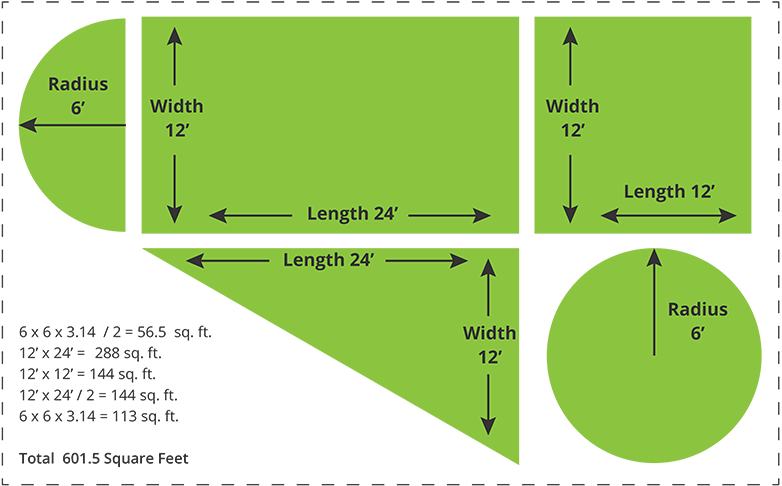
Image Source: gvt.net
Fathoming Your Lawn’s Dimensions: The Foundation of Successful Projects
Knowing the precise size of your lawn is not just about curiosity; it’s the bedrock of successful lawn care and landscaping. Whether you’re embarking on a mission to measure a lawn for sod, calculate the square footage of lawn for seed coverage, or simply want to know your lawn area calculation, accuracy prevents waste and ensures optimal results. This guide will equip you with the knowledge and tools to tackle this task with confidence, transforming potentially confusing geometry into straightforward steps.
The Essential Tools for Lawn Measurement
Before you head outside, gather your equipment. The right tools make all the difference in achieving an accurate lawn measurement tool.
- Measuring Tape: A long, sturdy measuring tape is your primary tool. A retractable one, at least 50-100 feet long, is ideal. For very large properties, a surveyor’s tape measure or a wheel measure might be more efficient.
- Stakes or Markers: These help you mark points for measurement, especially in irregularly shaped areas. Brightly colored flags or simple wooden stakes work well.
- Notebook and Pen/Pencil: To record your measurements clearly.
- Calculator: For performing the necessary calculations.
- Optional: Laser Measuring Device: For larger or more complex areas, a laser measure can speed up the process, but it can be less precise for uneven terrain or around obstacles.
- Optional: Measuring Wheel: Excellent for covering long distances quickly, especially on relatively flat surfaces.
Step-by-Step Guide: Measuring Your Lawn
The process of how to calculate lawn size can seem daunting, but breaking it down into manageable steps makes it easy.
Measuring a Rectangular Lawn
This is the simplest scenario. If your lawn is a perfect rectangle, you only need two measurements: length and width.
- Measure the Length: Start at one end of the lawn and extend your measuring tape in a straight line to the opposite end. Record this measurement.
- Measure the Width: Do the same across the lawn, perpendicular to the length. Record this measurement.
- Calculate the Area: Multiply the length by the width.
- Formula: Area = Length × Width
- Example: If your lawn is 50 feet long and 30 feet wide, the area is 50 ft × 30 ft = 1500 square feet.
This direct approach is key for any lawn installation measurements if your space is neatly defined.
Measuring an L-Shaped Lawn
Many backyards are not perfect rectangles. An L-shaped lawn is common. The trick here is to divide the L into two smaller rectangles.
- Visualize and Divide: Look at your L-shaped lawn. You can divide it into two distinct rectangular sections. Imagine drawing a line to split it.
- Measure the First Rectangle:
- Measure the length of one of the “legs” of the L.
- Measure the width of that same leg.
- Calculate the area of this first rectangle (Length × Width).
- Measure the Second Rectangle:
- Measure the length of the other “leg” of the L.
- Measure the width of that second leg.
- Calculate the area of this second rectangle (Length × Width).
- Calculate the Total Area: Add the areas of the two rectangles together.
- Example: Imagine an L shape. One rectangle is 40 ft x 20 ft (Area = 800 sq ft). The other is 30 ft x 15 ft (Area = 450 sq ft). The total lawn area is 800 sq ft + 450 sq ft = 1250 sq ft.
This method is essential for accurate backyard measurement when dealing with non-standard shapes.
Measuring a Circular Lawn
For circular areas, you’ll need to find the radius.
- Find the Diameter: Measure the distance across the circle through its center. If finding the exact center is difficult, measure across the widest point. This is your diameter.
- Calculate the Radius: The radius is half of the diameter.
- Formula: Radius (r) = Diameter / 2
- Calculate the Area: Use the formula for the area of a circle.
- Formula: Area = π × radius² (where π is approximately 3.14159)
- Example: If your lawn’s diameter is 20 feet, the radius is 10 feet. The area is 3.14159 × (10 ft)² = 3.14159 × 100 sq ft = 314.16 sq ft.
Measuring an Irregularly Shaped Lawn
This is where it gets a bit more involved, but still manageable with careful planning. The key is to break down the irregular shape into simpler, measurable shapes like rectangles, squares, triangles, and semi-circles.
- Sketch Your Lawn: Draw a rough sketch of your lawn on paper. Mark all the boundaries, trees, patios, and other permanent features.
- Divide into Sections: Divide your irregular shape into as many simple geometric shapes as possible (rectangles, squares, triangles, segments of circles).
- Measure Each Section:
- Rectangles/Squares: Measure length and width.
- Triangles: You’ll need to measure the base and the perpendicular height. For a right-angled triangle, measure the two sides that form the right angle.
- Formula (Base and Height): Area = 0.5 × Base × Height
- Circles/Semi-circles: Measure the diameter and calculate the radius as described above.
- Formula (Circle): Area = π × radius²
- Formula (Semi-circle): Area = 0.5 × π × radius²
- Calculate Area for Each Section: Apply the appropriate formula to each shape you’ve identified.
- Sum the Areas: Add up the areas of all the individual sections to get your total grass area calculator result.
Table: Common Shape Area Formulas
| Shape | Formula |
|---|---|
| Rectangle | Length × Width |
| Square | Side × Side (or Side²) |
| Triangle | 0.5 × Base × Height |
| Circle | π × Radius² |
| Semi-circle | 0.5 × π × Radius² |
Pro Tip for Irregular Shapes: If a section is truly an odd, curved shape that doesn’t fit standard formulas easily, you can approximate its area. Measure a series of short, straight lines along the curve to form a polygon. The more lines you use, the more accurate your approximation will be. This is particularly useful for measuring lawn for sod where you have naturalistic borders.
Precision Tips for Accurate Measurements
Even with the right tools and formulas, a few extra steps can enhance your accuracy.
- Check for Obstacles: Measure around trees, garden beds, patios, sheds, and other fixed objects. If these are within the lawn area you need to cover, you might need to exclude their area from your calculation or account for them in your design.
- Consider Slopes: Significant slopes can affect how much seed or sod you need, but for basic area measurement, measure the surface dimensions as they are.
- Measure Twice, Cut Once: Always double-check your measurements. It’s easy to misread a tape or make a calculation error.
- Use Consistent Units: Ensure all your measurements are in the same units (feet, meters). This is crucial for the lawn area calculation.
- Handle Curves Carefully: For curved boundaries, try to measure in segments or use a flexible tape measure laid along the curve. Alternatively, use a string to follow the curve, then measure the string’s length.
Using a Measuring Wheel for Larger Areas
For extensive properties, a measuring wheel can be a valuable lawn measurement tool.
- Calibration (if applicable): Some wheels have a reset button. Ensure it’s at zero before starting.
- Straight Lines: Walk in as straight a line as possible. A helper holding a flag at the end point can be useful.
- Record Increments: Read the measurement on the wheel’s counter. Note down the numbers, especially when crossing boundaries or turning.
- Perimeter Calculation: If you need the lawn perimeter calculation, simply add up all the lengths of the sides you measure around the lawn’s edge.
Calculating Lawn Area for Specific Needs
Knowing your square footage of lawn is fundamental for purchasing materials and planning treatments.
- Grass Seed: Seed bags typically state the coverage area in square feet per pound or bag. Knowing your lawn’s size ensures you buy enough seed without over or underestimating.
- Sod: Sod is sold in rolls or pieces of specific dimensions. Calculating your exact square footage is critical to ordering the correct amount, preventing both shortages and excess waste when measuring a lawn for sod.
- Fertilizer and Weed Control: The application rates for these products are always given per 1,000 square feet. Accurate measurement ensures you use the correct dosage for effective and safe application.
- Irrigation Systems: Designing an irrigation system requires precise knowledge of the area to be watered, including any irregular shapes or slopes.
Advanced Techniques and Tools
While simple measuring tapes and basic geometry suffice for most, advanced options exist.
- GPS Measuring Devices: Handheld GPS units or smartphone apps can estimate area by walking the perimeter. Accuracy can vary depending on satellite signal strength and the device’s capabilities. These are often good for a quick estimate but less reliable for precise lawn installation measurements.
- Online Mapping Tools: Services like Google Earth Pro or dedicated online mapping tools allow you to draw polygons over satellite imagery to calculate area. This is a great way to get a preliminary measurement from your computer.
Frequently Asked Questions About Lawn Measurement
Here are some common questions people have when measuring their lawns:
Q1: How do I measure a lawn with a hill?
A1: Measure the surface of the lawn as it lies. For most purposes, you are interested in the area you can walk on and maintain, not the aerial or projected horizontal area.
Q2: What if my lawn has a lot of flower beds and trees inside it?
A2: For calculating the total area you need to cover with seed or sod, you should subtract the area of these non-lawn features. Measure each feature (e.g., a circular flower bed) and subtract its area from the total lawn measurement.
Q3: How do I measure the perimeter of my lawn?
A3: The perimeter is the total length of the boundary of your lawn. Simply measure each side of your lawn and add all the lengths together. This is important for things like installing edging or calculating the amount of fence needed.
Q4: What units should I use for lawn measurements?
A4: Feet are most common in the United States for lawn measurements, leading to square feet for area. In metric countries, meters are used, resulting in square meters. Ensure consistency throughout your calculations.
Q5: How accurate do my measurements need to be?
A5: For materials like seed and sod, a small margin of error (5-10%) is usually acceptable. For precise landscape design or irrigation, greater accuracy is beneficial. Always round up slightly to ensure you have enough material.
By following these steps and utilizing the right tools, you can confidently measure your lawn, paving the way for successful gardening, landscaping, and lawn care projects. Happy measuring!