
Knowing how many acres is my yard is a common question for homeowners. Generally, a typical residential yard is much less than one acre, often falling between 0.1 and 0.25 acres. This blog post will guide you through measuring your lawn, calculating your yard size, and determining your property size in acres. We’ll cover everything from basic land area calculation to using handy tools like a lawn size calculator.
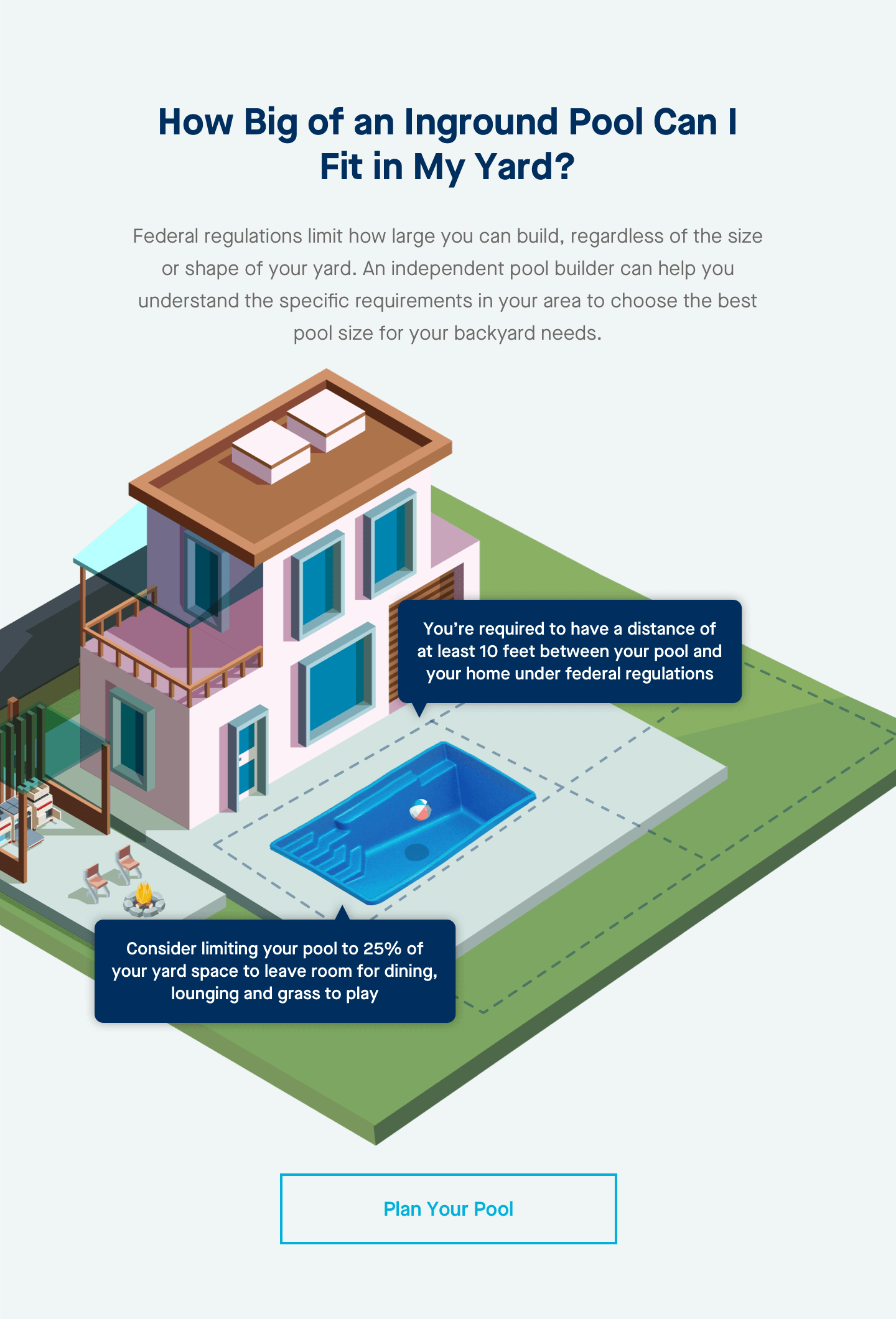
Image Source: www.lathampool.com
Why Knowing Your Yard’s Acreage Matters
Knowing your yard size isn’t just a fun fact; it has practical implications for property ownership. Whether you’re planning landscaping projects, considering a fence installation, budgeting for lawn care, or even thinking about future renovations, having a clear understanding of your land area calculation is essential. It helps you buy the right amount of seed, fertilizer, or mulch. It also impacts property taxes and can influence the value of your home. So, let’s dive into how to measure property and get that acreage number!
Practical Uses for Knowing Your Yard Size
- Landscaping: Planning a new garden, a patio, or a play area requires knowing the available space.
- Home Improvement: Zoning laws and building permits often depend on property size.
- Lawn Care: Estimating the amount of grass seed, fertilizer, or weed killer needed is much easier with accurate measurements.
- Fencing: Installing a fence requires precise measurements of your backyard dimensions or entire property boundary.
- Real Estate: When buying or selling, knowing the exact acreage is crucial for valuation.
- Watering Needs: Understanding your land area calculation helps you estimate how much water your lawn needs.
Deciphering Acreage: What Exactly is an Acre?
Before we start measuring, let’s clarify what an acre is. An acre is a unit of land area. It’s most commonly associated with the imperial and U.S. customary systems.
-
In simple terms: Think of it this way: if you were to lay out a rectangle that is 208.71 feet long and 208.71 feet wide, you would have exactly one acre of land. This creates a square shape.
-
Acreage Conversion: It’s important to know how acres relate to other common measurements like square feet.
Key Acreage Conversions
Here are some handy conversions to keep in mind during your land measurement:
| Unit | Conversion to Square Feet |
|---|---|
| 1 Acre | 43,560 square feet |
| 1 Hectare | 107,639 square feet |
| 1 Square Mile | 640 acres |
This means that a typical residential yard, which might be 5,000 to 10,000 square feet, is a small fraction of an acre.
How to Measure Your Yard: Step-by-Step
The most straightforward way to determine your yard size is by measuring it yourself. This process is also referred to as measuring your lawn. You’ll need a few basic tools.
Tools You’ll Need for Land Measurement
- Measuring Tape: A long measuring tape (100 feet or more) is ideal. A laser distance measurer is even better for longer distances.
- Paper and Pen/Pencil: To record your measurements.
- Calculator: To help with calculations, especially when calculating acreage.
- Measuring Wheel (Optional): Useful for very large areas or irregular shapes.
- Property Survey (If Available): This is the most accurate document, often showing exact dimensions.
Measuring a Rectangular or Square Yard
If your yard is a simple rectangle or square, calculating acreage is straightforward.
Step 1: Measure the Length and Width
* Stand at one corner of your yard.
* Measure the length of the yard along one side. Record this measurement in feet.
* Measure the width of the yard along the adjacent side. Record this measurement in feet.
Step 2: Calculate the Square Footage of Your Yard
* Multiply the length by the width.
* Formula: Length (ft) × Width (ft) = Square Footage (sq ft)
Step 3: Convert Square Footage to Acres
* Now, convert the total square footage to acres by dividing by 43,560 (since there are 43,560 square feet in one acre).
* Formula: Square Footage (sq ft) / 43,560 = Acreage
Example:
Let’s say your yard is 100 feet long and 75 feet wide.
* Square Footage: 100 ft × 75 ft = 7,500 sq ft
* Acreage: 7,500 sq ft / 43,560 sq ft/acre = 0.172 acres
Measuring Irregularly Shaped Yards
Most yards aren’t perfect rectangles. For irregular shapes, the land area calculation becomes a bit more involved. The best approach is to break the yard down into simpler geometric shapes like rectangles, squares, and triangles.
Step 1: Divide Your Yard into Simpler Shapes
* Walk around your yard and sketch its outline.
* Mentally or on your sketch, divide the yard into sections that are easily measurable (rectangles, squares, triangles).
* Try to cover the entire property size with these shapes.
Step 2: Measure Each Section
* For each rectangular or square section, measure its length and width.
* For each triangular section, measure its base and its height (the perpendicular distance from the base to the opposite vertex).
Step 3: Calculate the Area of Each Section
* Rectangles/Squares: Area = Length × Width
* Triangles: Area = 0.5 × Base × Height
Step 4: Sum the Areas of All Sections
* Add up the calculated areas of all the individual shapes to get the total square footage of your yard.
Step 5: Convert Total Square Footage to Acres
* Divide the total square footage by 43,560.
Example of Irregular Yard Measurement:
Imagine your yard is L-shaped. You can divide it into two rectangles.
- Rectangle 1: 50 ft × 30 ft = 1,500 sq ft
- Rectangle 2: 40 ft × 25 ft = 1,000 sq ft
- Total Square Footage: 1,500 sq ft + 1,000 sq ft = 2,500 sq ft
- Acreage: 2,500 sq ft / 43,560 sq ft/acre = 0.057 acres
Using a Measuring Wheel for Land Measurement
A measuring wheel is excellent for following longer or curved boundaries.
- Start at a point.
- Walk along the edge of your property, rolling the wheel.
- Record the total distance shown on the wheel.
- If you have irregular shapes, you might use the wheel to measure the length of curves and then use geometry or online tools to estimate the area of those curved sections.
Utilizing Your Property Survey
If you have a copy of your property survey, how to measure property becomes incredibly simple. The survey plat usually shows the exact dimensions of your property lines in feet.
- Locate the dimensions on your survey. They are often marked along the property lines.
- Identify the total length and width or the dimensions needed to calculate the total area.
- Calculate the total square footage using these dimensions.
- Convert to acres by dividing by 43,560.
A survey is the most precise way to know your property size.
Calculating Acreage Using Online Tools and Apps
In today’s digital age, you don’t always need a tape measure. There are fantastic online tools and apps that can help with calculating acreage. These are often referred to as a lawn size calculator.
Using Google Maps and Similar Tools
Google Maps and other satellite imagery services can be surprisingly accurate for measuring your lawn.
Steps:
- Open Google Maps (or a similar service).
- Search for your address.
- Zoom in to see your property clearly.
- Right-click on one corner of your yard.
- Select “Measure distance.”
- Click on subsequent corners of your yard to trace its perimeter.
- The tool will display the total distance. To get the area:
- For simple shapes, you can measure length and width.
- For more complex shapes, Google Maps’ measurement tool can often calculate the area directly if you close the loop.
- If it only gives you perimeter measurements, you might need to estimate the area based on those, or use the tool to measure individual sections of your property.
Tips for Accuracy with Satellite Tools:
- Ensure the imagery is recent.
- Use the tool to measure key straight sections and then estimate curved ones.
- Remember that these are estimations. For critical measurements, physical measurement or a survey is best.
Dedicated Lawn Size Calculator Apps
Many smartphone apps are designed specifically for measuring property and yards. These often use your phone’s GPS and camera to help you outline your property.
- How they work: You typically walk the perimeter of your yard with your phone, and the app records your location. It then uses GPS data and mapping to calculate the square footage of your yard and convert it to acreage.
- Benefits: Convenient and can be quite accurate for larger, well-defined areas.
- Considerations: GPS accuracy can be affected by buildings, trees, and weather.
What is My Property Size in Square Feet?
Before we even get to acres, it’s vital to know your square footage of your yard. This is the foundation of calculating acreage.
Let’s look at common yard sizes in square feet and their acreage equivalents:
| Yard Size (Square Feet) | Acreage (Approximate) | Common Description |
|---|---|---|
| 3,000 sq ft | 0.07 acres | Smaller urban lot |
| 5,000 sq ft | 0.11 acres | Average suburban yard |
| 7,500 sq ft | 0.17 acres | Larger suburban yard |
| 10,000 sq ft | 0.23 acres | Quite a spacious suburban yard |
| 15,000 sq ft | 0.34 acres | Large lot, typical of older neighborhoods or rural |
| 20,000 sq ft | 0.46 acres | Very large lot |
| 43,560 sq ft | 1 acre | A full acre |
This table helps you get a feel for the scale of different yard sizes when measuring your lawn.
Interpreting Your Yard Size: Common Yard Dimensions
To give you a better sense of how many acres is my yard, let’s consider common backyard dimensions and how they translate into acreage.
Typical Suburban Lot
- Dimensions: Often around 75 feet wide by 100 feet deep.
- Square Footage: 7,500 sq ft
- Acreage: 7,500 / 43,560 = 0.17 acres
Larger Suburban Lot
- Dimensions: Could be 100 feet wide by 150 feet deep.
- Square Footage: 15,000 sq ft
- Acreage: 15,000 / 43,560 = 0.34 acres
Urban Townhouse Lot
- Dimensions: May be quite narrow, like 25 feet wide by 100 feet deep.
- Square Footage: 2,500 sq ft
- Acreage: 2,500 / 43,560 = 0.06 acres
These examples show that most residential yards are only a fraction of an acre. When you hear about properties measured in whole acres, it usually refers to larger rural estates, farms, or commercial properties.
Fathoming Your Property Size: Beyond the House Footprint
When you’re measuring your lawn, remember that your property size often includes more than just the grassy area. It typically encompasses:
- The house footprint
- Driveways
- Patios and decks
- Flower beds and gardens
- Sheds or other outbuildings
- Any open grassy areas
- Even parts of the sidewalk or easement in front of your house, depending on how your property lines are defined.
Your survey is the best place to see the exact boundaries of your property size.
Tools for Accurate Land Measurement
Let’s revisit some tools that enhance accuracy in land area calculation.
Laser Distance Measurer
- How it works: Projects a laser beam to a target. It measures the time it takes for the beam to return, calculating the distance.
- Pros: Very accurate for straight lines, can measure longer distances than most tapes, often calculates area and volume. Easy for one person.
- Cons: Can be expensive, requires a clear line of sight.
Measuring Wheel (Trumeter)
- How it works: A wheel with a counter that spins as you roll it along the ground.
- Pros: Good for very long distances or following contours. Relatively inexpensive.
- Cons: Less precise on uneven or very curved surfaces. Can be harder to get an exact starting and ending point.
GPS and Mapping Apps
- Pros: Convenient, accessible via smartphone, can be used for on-site measurement.
- Cons: Accuracy can vary greatly due to satellite signal interference. Best used for estimating unless you have a high-accuracy GPS device.
Frequently Asked Questions (FAQ) About Yard Acreage
Q1: What is the average yard size in acres?
A1: The average residential yard is typically between 0.1 and 0.25 acres, which translates to roughly 4,356 to 10,890 square feet.
Q2: Can I measure my yard with just a tape measure?
A2: Yes, you can measure your yard with a tape measure, especially if it’s a relatively small and simple shape. For larger or more complex yards, a longer tape or a laser distance measurer might be more practical.
Q3: Who can I hire to measure my property for me?
A3: You can hire a professional land surveyor or a landscape architect to accurately measure your property and provide detailed plans.
Q4: How do I calculate acreage if my yard has curves?
A4: For curved areas, you can approximate the area by dividing the curve into several short, straight line segments and treating each segment as part of a rectangle or triangle. Alternatively, advanced geometry or specialized software can provide more precise calculations.
Q5: What’s the difference between lot size and yard size?
A5: Lot size typically refers to the entire parcel of land owned, including the house and any structures. Yard size usually refers specifically to the outdoor living space or the area around the house that is not built upon. However, in common conversation, people often use “yard size” to mean their entire “lot size.”
Q6: How accurate are online lawn size calculators?
A6: Online calculators that use satellite imagery (like Google Maps) can be quite accurate for estimating, but their precision can be affected by image resolution and age. Apps that use GPS can also vary in accuracy based on your phone’s capabilities and environmental factors.
Q7: Is one acre a big area for a yard?
A7: Yes, one acre (43,560 sq ft) is a very large area for a typical residential yard. Most people live on properties that are a fraction of an acre.
Q8: What if my property line is not clearly defined?
A8: If your property lines are unclear, or if you have disputes with neighbors, the best course of action is to consult a licensed land surveyor. They can officially mark your property boundaries.
Conclusion: Your Yard’s Acreage in Hand
By now, you should have a much clearer picture of how many acres is my yard. Whether you used a tape measure, a laser tool, or an online lawn size calculator, you’ve taken the first step in accurately knowing your property size. This knowledge empowers you for any project or decision related to your home and its outdoor spaces. Remember, precise land measurement can save you time, money, and hassle in the long run, ensuring your landscaping, renovations, or general lawn care efforts are planned with certainty.